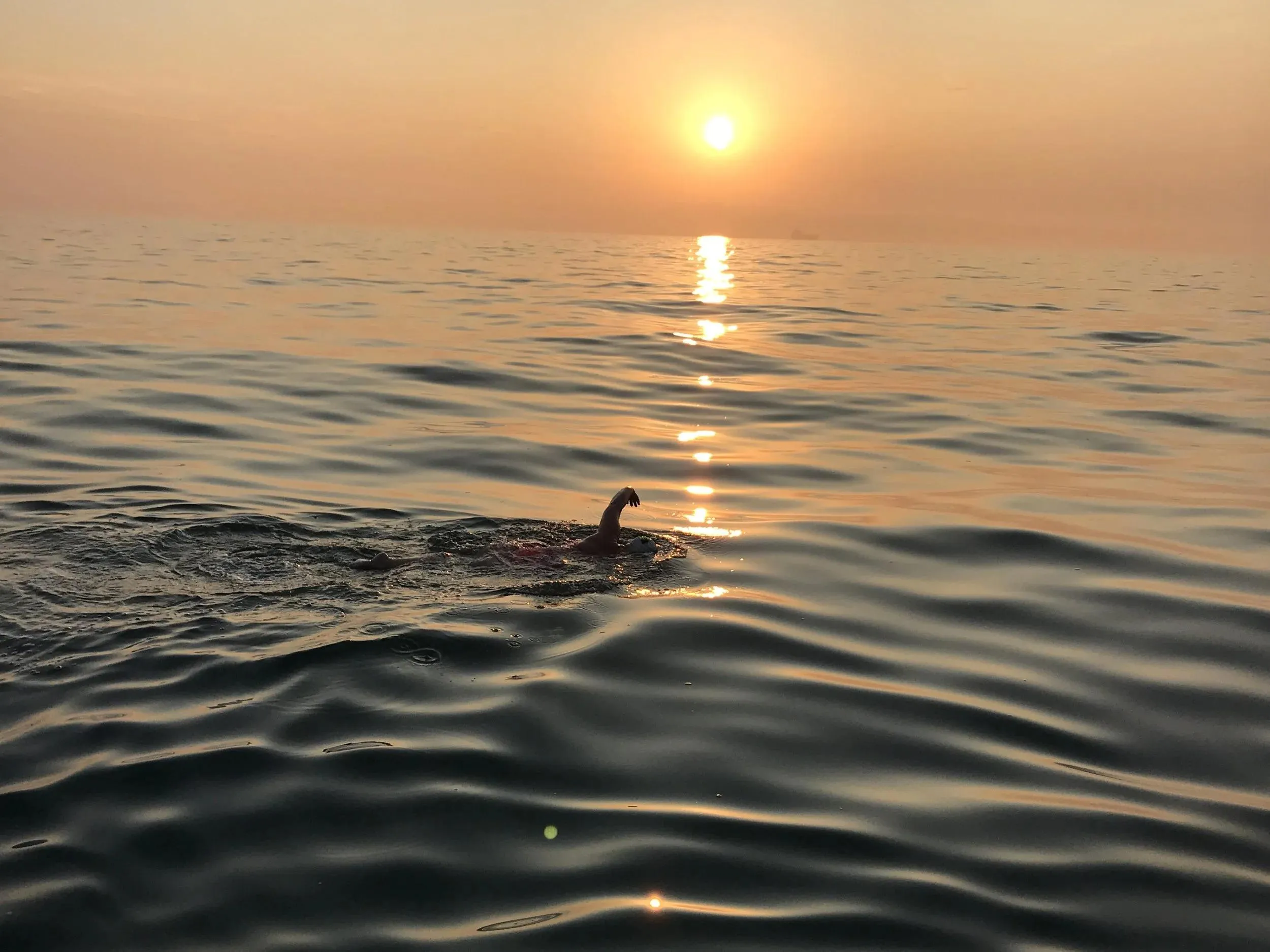

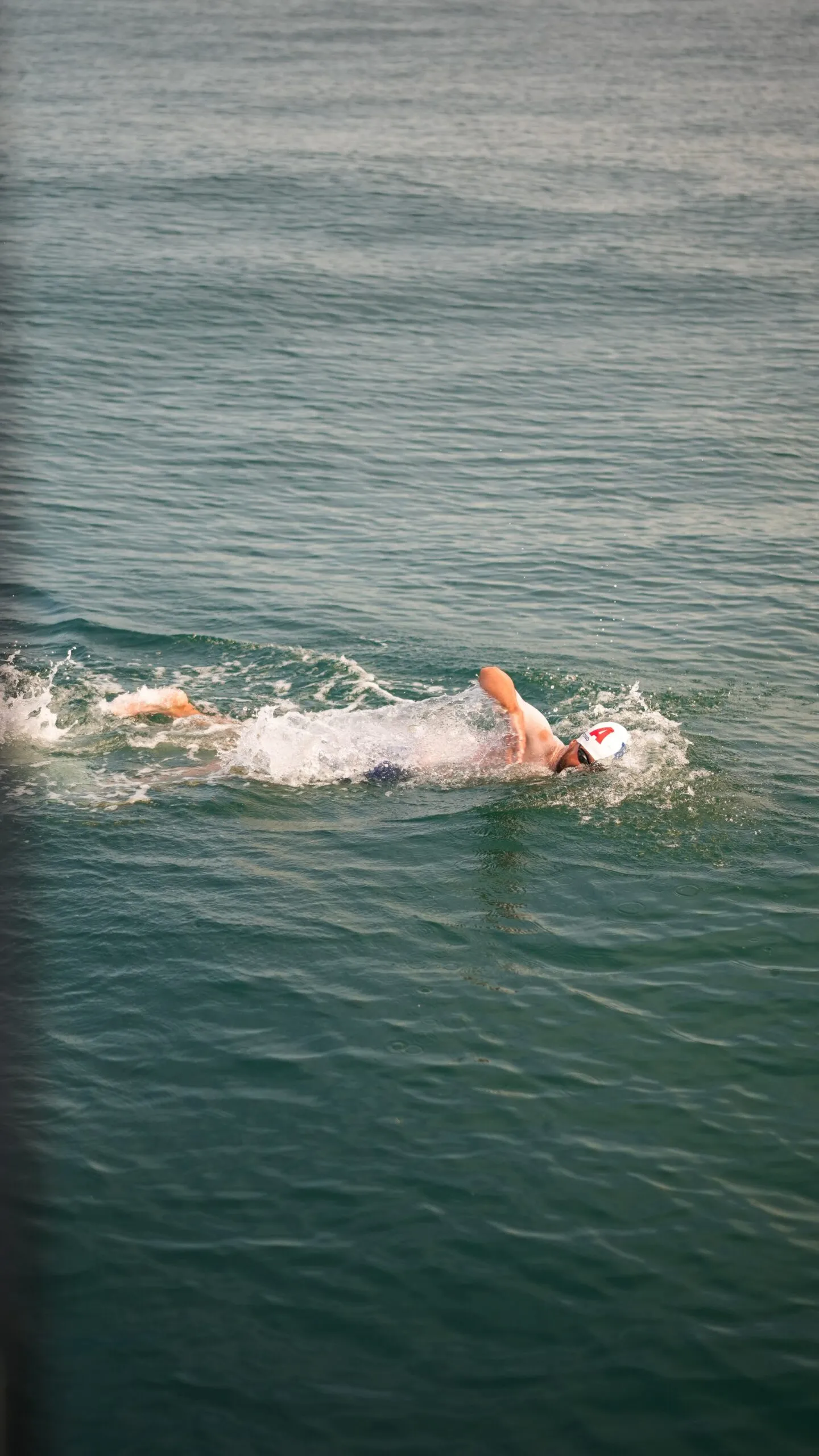
On Sunday, 23 August, Axel Reymond set a new French record for the English Channel swim, completing the crossing in 7 hours, 7 minutes and 8 seconds.
For this record attempt, he enlisted the help of extreme swimmer Stéphane Krause. To our knowledge, this was a first in France: working together to determine the best possible route to achieve his goal, as well as the ideal departure date and time based on weather conditions and ocean currents.
Stéphane Krause is not just a swimmer. He is also the coach of the French national funboard team at the French Sailing Federation and works with the French Offshore Racing Centre (Pôle France Course au Large). He is therefore an expert in navigation, with extensive experience in analysing weather forecasts and ocean currents in detail.
Although Axel did not manage to break the world record as he had initially hoped, this collaboration highlights the potential benefits of having a route navigator on board for swimmers looking to achieve personal milestones. As has been common practice in sailing for many years, expert route planning could help swimmers complete their crossings in the best possible conditions.
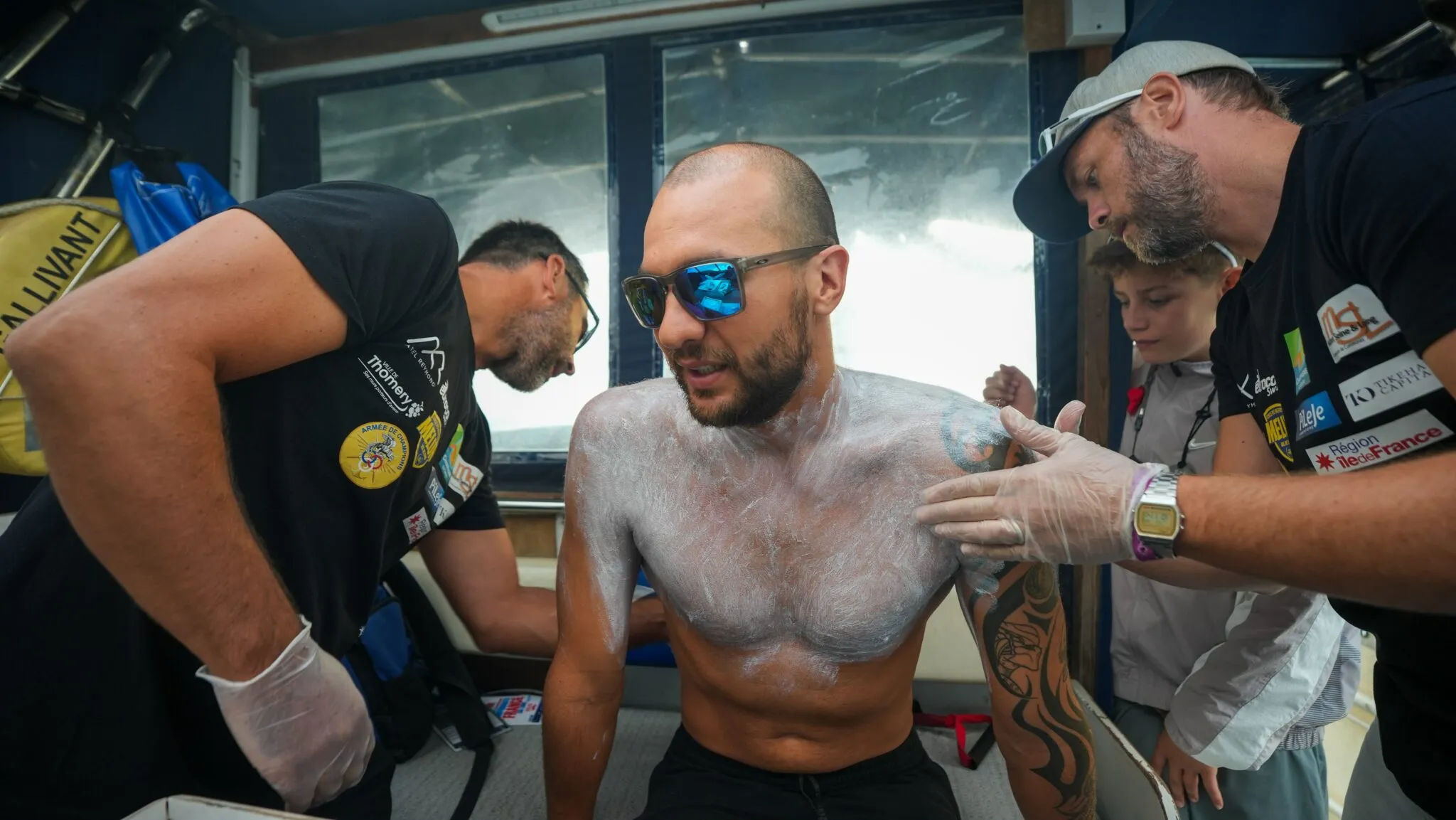
Laurent Neuville – To my knowledge, this is the first time that an elite swimmer and a competitive sailing expert have worked together in an attempt to break a record for an English Channel swim. Could you explain how you came to work together?
Axel Reymond – It all started when I called Stéphane Lecat, former Director of Open Water Swimming at the French Swimming Federation and now Technical Director of the French Triathlon Federation. I basically told him: “I need some help. I don’t know what to do because the pilot of my support boat keeps sending me rather contradictory emails. Our conversations really aren’t going well. He really doesn’t want me to attempt the crossing this year.”
I really wanted to go ahead with it this year because my sponsors had already been waiting almost four years for me to complete the crossing. I really wanted to get it done and finally put an end to all those years of waiting. I was also tired of having to give up my summer holidays every year to prepare for it. So I wanted to do it and finally get it over with!
Stéphane Lecat asked me why I wasn’t going ahead and what the problem was with the pilot. I told him about the weather, and he said: “Listen, I know someone. I’ll give you his contact details. Talk to him and ask for his advice.” That’s when he put me in touch with Stéphane Krause. At first, I didn’t really dare to call him, but Stéphane insisted.
Laurent – So you followed his advice!
Axel – Well, I didn’t have much choice! When Stéphane Lecat tells me: “Axel, call Stéphane!”, I just say: “Yes, captain! I’ll call Stéphane!”
Laurent – And Stéphane, how did you react when you received this request?
Stéphane Krause – What’s interesting is that when the two of us met at a training camp in Quiberon last July, you told me it would be great if I could speak with Axel and that you could work together on something. You thought it would be interesting for us to meet given our different backgrounds as swimmers.
Then, out of nowhere, I received a call from Stéphane Lecat saying: “I’ve given Axel your number. Is that okay with you?” And shortly afterwards, Axel called me. He explained his situation and the difficulties he was facing, and I found the whole thing quite astonishing.
I wasn’t very familiar with how English Channel crossings are organised, particularly the requirement to go through an official pilot, who essentially has a huge say in whether or not a swimmer gets to make the crossing.
At that point, I thought: “This guy has what it takes to break the record. It’s August, and the weather is relatively favourable at this time of year, although you never know.” So I quickly told Axel: “I’ll take a look at it!”
I started looking into it, and what surprised me was that Axel told me two separate windows had already been agreed with the pilot: one at the end of August, with a four- or five-day waiting period, and another around 19 September. The pilot had apparently told him these were the best periods for breaking the record.
That surprised me a little. “How could he know more than a month in advance that these would be the best periods, based solely on weather statistics from previous years?” On top of that, the pilot was telling Axel: “We’ll postpone it. It’s better if you go in September.”
From then on, I started looking closely at the forecasts, probably about a week beforehand, to see whether we could find a more favourable window during the first waiting period.
Axel and I exchanged information every day for a week to refine the forecasts. Each day, I checked the wind and currents in relation to the changing tides to determine the best possible window, and above all, the best departure time.
What I hadn’t fully realised, despite knowing about the difficulties Axel was having with his pilot, was that the latter was an old grump who struggled to accept that anyone might question his certainties and his knowledge of the English Channel.
Eventually, it took me longer than expected to identify the best departure option. Gradually, I started to settle on Saturday 22 and Sunday 23 August. If I remember correctly, Saturday looked more favourable, but Axel told me the pilot was ready and that he could leave earlier.
I replied: “Yes, you could leave between Thursday and Friday. The crossing would be perfectly possible, but we’re talking about breaking a record here, not simply completing a crossing.”
In the end, the pilot wasn’t entirely wrong when he suggested that Sunday was probably the best day to make the crossing.
Looking more closely, I could see that breaking the record was possible, but it was absolutely essential to stick to the departure time and the planned route.
So I suggested a very precise route and departure time to Axel to make the most of the currents. However, the pilot wanted to leave early, which didn’t really make sense to me given the current conditions.
I therefore told Axel: “Take as much time as you need to get changed, get into the water and make sure you start at exactly 9:30 a.m. That way, you’ll be in sync with the current.”
To prepare the best possible route, I had also studied the course and current strength during Andreas Waschburger’s record-breaking crossing (completed on 8 September 2023 in 6 hours and 45 minutes), to see whether we could follow the same route or even find a more efficient one.
Compared with the record-holder’s route, I had suggested a course further towards the south-east. But for that to work, Axel needed to convince the pilot to agree to a later departure and follow the right route.
Laurent – Axel, now that you had all the information you needed, how did you manage to convince the pilot to follow Stéphane’s advice?
Axel – Before that, I should explain just how difficult it was to secure a departure window.
On Wednesday, when we were on the boat with my team heading towards England, we received an email telling us that we might not be able to make the crossing after all.
Then we received another email saying that Sunday might work, that very little wind was forecast and that there was potentially a suitable weather window.
So I went straight to the pilot and tried to negotiate with him. He told me: “Listen, Axel, I don’t see a good window for breaking the record. But we can still make the crossing if you want.”
At that point, I thought it was going to be frustrating because I was there to attempt the record. But given how much everyone around me was expecting this crossing to happen, I told myself that the record wasn’t everything. I was there to make the crossing, and if a record came out of it, all the better! Worst case scenario, I could try again next year or in the years after that.
After agreeing with the pilot that we would go ahead with the crossing, he told me: “Listen, I’ll keep you updated day by day and let you know the departure date and time.”
It was Thursday, and Stéphane and I were discussing plans for a Saturday or Sunday morning departure. We had agreed on the schedule, but the following day at midday, I received an email from the pilot confirming that we would leave on Sunday morning because the wind wasn’t too strong, or alternatively the following Wednesday. It was basically take it or leave it.
So I chose Sunday morning.
Laurent – So the date was finally set. Did you manage to get the pilot to follow Stéphane’s recommendations, particularly when it came to delaying the departure time?
Axel– The pilot wanted us to leave at 8:30 a.m. I told him: “I’ve spoken to a friend who works in sailing and is extremely knowledgeable in his field. He recommends that we leave at around 10 a.m.”
He replied that the record was no longer possible anyway, and that we could leave whenever we wanted.
So I told him we would leave at 9:30 a.m. He said: “Okay, no problem. Let’s meet at such and such a time.”
And that was pretty much how it happened. He seemed to have a rather couldn’t-care-less attitude about the whole thing!
Laurent – Here we are. It’s 9:30 a.m. and you’re getting into the water. How did the crossing go, and what prevented you from breaking the world record?
Axel – I was kept informed throughout the swim. I started swimming at my usual pace, and after two hours, my team told me: “The record is no longer possible. You’re more than 20 minutes behind.”
After three to three and a half hours of swimming, they told me I was 40 minutes behind and that it was over.
So I decided to ease off a little and just enjoy the swim.
Laurent – So you thought: “It’s over now, I might as well enjoy it”?
Axel – Exactly! I started enjoying the experience. I looked at the boats and the seals swimming nearby, trying to take in everything around me. Then, at some point, I can’t remember exactly, probably after four or five hours of swimming, my team told me I was starting to make up time and claw back a few minutes. I said: “Okay, let’s pick up the pace a little!” So I accelerated, and they kept telling me I was gradually closing the gap. I was now only 25 minutes behind the record. From that moment on, I gave it everything I had and eventually finished just 22 minutes outside the record time.
Laurent – Do you think you could have broken the record if you hadn’t eased off during part of the crossing?
Axel – The problem was that the pilot didn’t follow the route Stéphane had proposed. He took us on a straight-line course, whereas Andreas had followed a curved route during his record attempt to take advantage of the currents.
By benefiting from those currents, I could have made up a lot more time. That’s really what put us at a disadvantage in our record attempt.
Laurent – Stéphane, how did you experience Axel’s crossing from your side?
Stéphane – I couldn’t actually follow him live because there was a problem with the tracking device and it wasn’t working.
I followed his crossing through Instagram, using the photos and posts shared by his team.
They weren’t giving any timing updates until they posted a photo showing the coastline with the caption: “Only 45 minutes left to break the record.”
I thought: “That’s it, he should make it! The current will carry him along and things should move quickly.”
Then, 25 minutes later, another photo appeared, but the coastline still looked incredibly far away.
Given how fast he was swimming, I thought he could still make it. I was completely caught up in it, incredibly stressed. All I wanted was for him to break that record because I knew he was capable of it.
But after a while, I started thinking: “This is strange. There hasn’t been any news!”
And that’s when it became clear that the record hadn’t been broken.
**Laurent –**Tu as dû être un peu frustré d’apprendre que le record n’avait pas été battu ?
Stéphane – Absolutely!
After everything we’d been through together remotely, all those phone conversations during the preparation and the great connection we’d built, yes, it was frustrating.
When I think back to all the time we spent discussing the strategy and all the work I put into it, I was completely invested.
During the debrief with Axel, I asked him for the GPS track of his crossing. When we compared his actual route with the one I had sent him beforehand, we were both absolutely stunned to see that the pilot hadn’t followed the original plan.
Axel told me there had been a real battle on the boat with his team as they tried to get the pilot to change course. But the guy simply wouldn’t listen.
As a result, Axel ended up swimming against the current, or at least having to fight it towards the end of the crossing.
Seeing that really made me angry. At that moment, I thought: “The pilot has stolen this record from him. It’s dishonest, it’s a complete rip-off, and there’s nothing you can do about it.”
Laurent – Axel, despite everything, you didn’t come away empty-handed. You broke the French record with a time of 7 hours and 7 minutes. Who held the previous record, and looking back, are you happy to have broken it?
Axel – The previous record was held by Gilles Rondy, a former French national open water swimmer, with a time of just over 7 hours and 40 minutes.
Looking back, honestly, setting a new French record is already a great achievement. It’s a fantastic performance.
That said, during the debrief with Stéphane afterwards, I was really disappointed when I saw my actual route. The pilot cost us the record by failing to follow our recommendations.
I have emails proving that he had received all the information and instructions we needed to break the record.
But ultimately, what I choose to remember is that I was lucky enough to complete the crossing, and the satisfaction of reaching the rocks and seeing my family and everyone who had come to welcome me.
Laurent – Now let’s talk about what’s next. What are your plans, Axel? I recently read that you were planning to complete all the crossings of the Oceans Seven in the coming years. Is that right?
Axel – Before attempting major long-distance swims following the English Channel, my next goal is to qualify for the 2028 Olympic Games in Los Angeles.This will be my final attempt, and I’m going to give it everything I’ve got to at least make it there.
After 2028, I do indeed plan to spend three or four years completing as many major crossings as possible, including those of the Oceans Seven, the Manhattan Island Marathon Swim and the Santa Fe crossing.
Laurent – And what about you, Stéphane? Does this first collaboration as a swim navigator open the door to more projects like this?
Stéphane – Axel and I worked really well together, and it was a great experience.
There is definitely an opportunity to help swimmers with route planning and navigation. At the very least, that means analysing weather conditions.
But analysing the route and the currents is also extremely important, particularly over such long distances.
Axel and I have discussed this. Even in highly structured events such as 25 km or 10 km races, local water conditions can create challenges involving currents or changing weather patterns. As the day progresses, these can have a real impact on race tactics.
There are times when the sea conditions can change because of currents or weather, or when swimmers pass a particular turning point. Depending on the location, this can mean adjusting the route slightly to take advantage of a favourable current or a particular current flow, or to deal with wave action and backwash.
So yes, I found the experience fantastic, and I think there is real potential to help swimmers and coaches prepare as effectively as possible and develop the right strategies for long-distance crossings or official competitions.
Of course, it also puts a certain amount of pressure on you, because it’s quite stressful to be involved in deciding on the best strategy.
But yes, why not? It was a real pleasure working with Axel, and I’d be more than happy to work with other swimmers if they’re interested.
Laurent – Finally, Axel, do you think there is a real case for swimmers to use a route navigator, as is already common practice in sailing?
Axel – When you take part in open water swimming competitions, you don’t really have this issue. You race on the scheduled day, at the scheduled time, and in whatever conditions happen to be there.
But with a long-distance crossing, you have a choice of dates and weather windows. You pay to be able to set off when conditions are right, so ultimately, you’re the one making the decision. From now on, when putting together sponsorship budgets for my future crossings, I’ll always include a specific budget for hiring a route navigator. And without wanting to flatter him too much, I already know I’ll ask Stéphane to work with me because he’s an excellent communicator and teacher, and we got on really well. Even though I didn’t achieve what I set out to do, bringing Stéphane on board was still the best decision I made.
Interview conducted in French by Laurent Neuville on 12 October 2026